Paper Content: Solar Loops
1. Summary
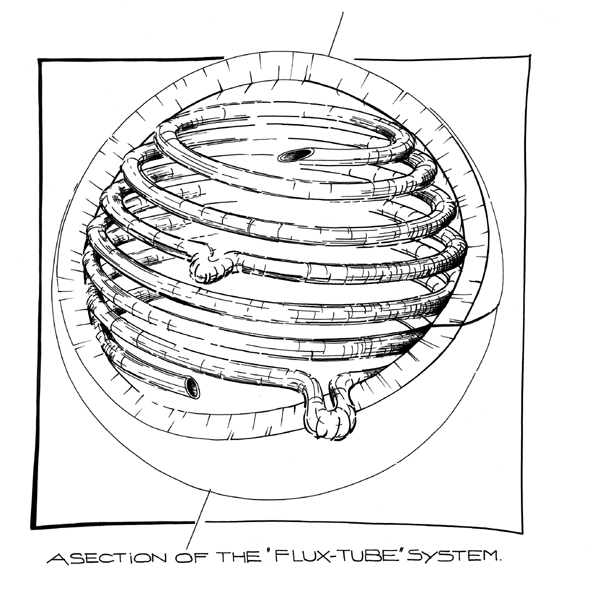
For many decades, solar loops were regarded as dynamo-generated, empty magnetic flux tubes. These were assumed to be lifted from deep layers by buoyancy forces and subsequently filled with hot plasma. This model was introduced to explain the filamentary form, deep origin, and ionic composition of solar loops. However, new observations from SOHO and TRACE reveal characteristics that require a fundamentally different explanation.
The electric model accounts for the much smaller mass of the electron compared to positive ions. This mass difference leads to a solar thermoelectric effect and the separation of negative and positive charges due to a solar temperature gradient of approximately 15 MK. This model explains not only the origin, shape, and ionic composition of these filaments, but also matter transport, missing sections, and their lack of infrared emission.
This new model resolves the coronal heating problem and does not require a dynamo. Attempts to realize such a dynamo experimentally (e.g. the Na-model in Karlsruhe; Wöhl 1998) have failed. The present report explains not only solar loops but also filamentary structures throughout the Universe.
2. Magnetic explanation of solar loops
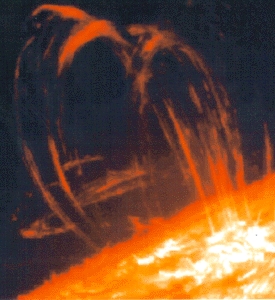
After a flare, such loops appear at the solar surface, emerging almost vertically from highly active regions visible as bright white areas. These regions are not parallel, nor do they resemble surfacing tubes. The loops exhibit significantly lower emission intensity than the active regions themselves.
Observations from the Big Bear Observatory indicate matter flowing along these loops in the form of clouds or knots. Several of these clouds exceed the loop diameter by more than a factor of two, contradicting the hypothesis that matter is transported inside thin magnetic tubes.
Two loops transport matter horizontally toward the surface—a motion that cannot be explained by buoyancy forces. Additionally, many loops exhibit missing sections within similar spatial regions (Wöhl 1997; Matthei 1999).
3 Electric explanation
Magnetic charges do not exist, only electric charges exist. Therefore, the observed solar macroscopic magnetic fields should be explain via macroscopic electric charges and not via mysterious magnetic machines without any electric circuit. The observed ions (of e.g. Fe XIV) can be explained either via high temperature (of 1.8 MK) or via electric ionisation. But the total absence of an infrared radiation of these ions in the solar- and coronal loops and the well known corona-problem show that only the electric ionisation can be possible. This electric ionisation is well known in the mercury fluorescent lamps. Does the Sun ionise in this cold way? Yes, it does ionise its own matter simply and without any mystery. But this cold way of ionisation leads to a new astronomy which is based on physics.
The totally new astronomical theory starts at the fact that the electron has a 1848 times smaller mass than the proton. Proton and electron are exactly equal in their absolute electric charges but they are very unequal in their masses. The negative electricity is bound to a light particle and the positive to much heavier particles. Iron ions have a mass of about 100 000 times that of an electron. This big asymmetry was not taken into account in the astronomy up to 1996 (Fig. 3 ).
Two loops transport matter horizontally toward the surface—a motion that cannot be explained by buoyancy forces. Additionally, many loops exhibit missing sections within similar spatial regions (Wöhl 1997; Matthei 1999).
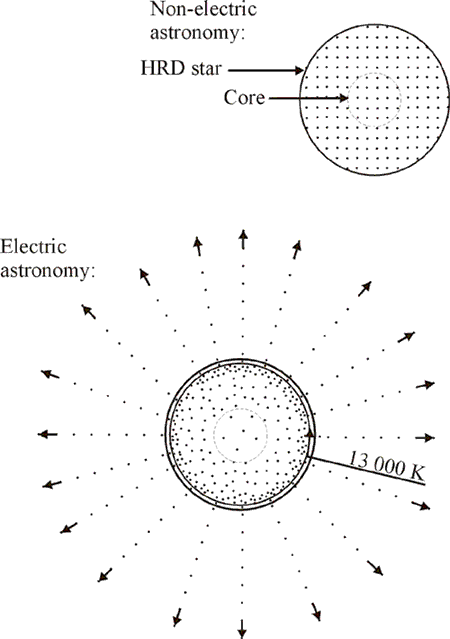
The body of a star was taken as electrically neutral in the past. Only exceptions are: the particles of the cosmic rays and the rings of planets. In all other cases, every m³ of a star was considered as containing the same positive and negative charges. More than 200 contradictions (e.g. corona-problem and neutrino-problem) are present in this astronomy (Körtvélyessy 1998). The reality shows quite another picture which is easy to calculate (Fig.3). All conductors are negatively charged in their colder sections and positively charged in their warmer sections. Due to the Boltzmann-equation:
the protons have everywhere 43 times lower velocity than the electrons and, therefore, the electrons have a higher density in a section of a conductor of a lower temperature (43² = 1848; and "m, v, T" are the mass, velocity and temperature of a particle and "k" is the Boltzmann constant). Therefore, in a HRD-star, the hot core loses electrons and the surface has a negative overbalance due to the surfacing electrons. This is symbolized by the few (five) black dots - i.e. electrons - in the core in Fig.3 (larger picture) and black dots of a high density near the surface. In this electric model, the gravity cannot close the surface of the star against the much stronger electric repulsion.
This asymmetry shows that all HRD-stars are electric generators due to the described thermoelement-effect. The Sun - or any other conductor - has a constant voltage of 2 000 V according to the Boltzmann equation (1) as long as it has a temperature-difference of 15 MK.
The Sun is no mysterious dynamo but the simplest thermoelement-generator of only one conductor. (The Pu-generator of the spacecrafts functions similarly due to a temperature-difference of some hundreds Kelvin but with many conductors.) The Sun’s positive pole is in its core, its negative pole is on its surface, its voltage is 2 000 V (1). All solar electromagnetic properties can be understood via this simple and evident model. This new model starts at these separated electric charges and not at mysterious magnetic fields of unknown origin. No dynamo is necessary. The negative solar wind is the cause of the positive charge of the solar core. Core-fragments can appear as positive charge on the solar surface causing a cold and local ionisation.
Every constant temperature-difference - and therefore also the solar 15 MK - can be a clear thermodynamical source of a power, in this case of an electric power due to the separation of the negative charge from the originally neutral matter in the Sun. These thermoelement-electrons appear in the solar hydrogen layer at about 13 000 K. The electrons in overbalance release an electrostatic explosion here and sweep away matter electrostatically and mechanically from this layer, mostly protons which are actually free by thermal dissociation. This is the solar wind. No magnetic field is necessary. The temperature-difference of 15 MK or the 2 000 eV energy of the particles in the solar core produces the emission of the solar wind. Theoretically, if the main mass of the wind is given by protons, the equation (1) predicts a wind-velocity of about 600 km/s. (The measured value is 750 km/s, the cause of the difference is not known yet. However, already the cause of the solar wind was unknown in the non-electric astronomy.) The resulting positive charge of the core appears on the surface due to supposed internal explosions which have a clearly measured influence on the solar rotation, oscillation and diameter. The surfaced fragments of these explosions appear as positive matter of strong hydrogen alpha emission shown by white spots in Fig. 1. These positive spots have the temperature of the solar surface of 5778 K and no 30 000 K. Their light is cold, the surfaced protons recombine with thermally dissociated electrons. This is the cause of the invisibility in infrared of all solar and coronal loops. But how can these positive - and therefore active - masses produce loops?
The positive charge of these masses causes in the depth of the Sun only a lower density and no electrostatically explosion, because the carriers of the electrostatic force i.e. the photons have a very long zig-zag path in the plasma. This lower density causes a low buoyancy force, simply hydrostatically. An electrostatic explosion comes, however, into existence when the elevating positive fragment cools down below dissociation-temperature (of about 13 000 K, see Fig.3). Suddenly, the free protons - which remain alone during the recombination - repulse each other very strongly. The photons fly suddenly in straight lines. Due to the continual transport from the depth, the free protons in the highest layers were pushed by the free protons in the lower layers, therefore the highest layer elevates into space, almost horizontally.
But now, every proton in elevation means a positive electric current. Parallel currents attract each other ! Due to this attraction, the charged matter does not explode electrostatically, but forms a filament electrodynamically. The cross section is minimal i.e. a circular cross section is formed.
This process is similar to the formation of stars. Gravity forms spheres which have a minimal volume with circular cross section, but electrically charged matter in motion forms filaments of circular cross section (Klimchuk ). In both cases, the circular cross section is the minimal cross section.
4 The main characteristics of the solar loops can be understood for the very first time
- The solar loops can be easily observed in hydrogen alpha light because the surfaced free protons are flying in these loops and they emit this cold light when they recombine with dissociated electrons.
- The solar loops are invisible because they are not hot. Therefore, they also do not have an infrared radiation. Important: the solar loops are neither hot nor cold ! They do not have a high temperature of 20 000K. They are not cold because they do not contain particles of a thermal zig-zag motion. "Hot" and "cold" have no meaning for the solar loops. The particles fly parallel to each other in the loop without colliding.
- The solar loops start from the solar surface vertically because the deeper layers of the surfaced positive charged matter (white spots in Fig. 1) repulses the upper layers. The elevating positive matter means parallel currents which attract each other. The result is the forming of filaments which vertically start from the center of each active area. This electric process can be demonstrated by electric discharge. In a shown model, the active areas have a diameter of 8 mm and the filaments of a diameter of 3 mm started perpendicularly to the surface and from the centre of the round active areas. All filaments of this model have an exact circular cross section similarly to the cross sections of the solar loops.
- The active areas seem to be brighter than the loop in hydrogen alpha light (white areas in Fig. 1) because these areas cause the loops and not the loop ( or the dynamo) causes the active area. For coronal loops, these areas are called "X ray bright points".
- The solar loops transports matter. But no matter is flowing in a magnetic tube due to a mysterious and never shown, only supposed hydrostatic pressure difference ! Cause and effect are exactly opposite. The elevating charged matter is repulsed electrostatically by the active area and the flight of this charged matter alone produces the "tube" of a circular cross section. In other words: the loop gives no possibility for matter to be transported but the charged matter in flight produces the loops. Neutral matter cannot form filaments, therefore, non-electric astronomy cannot understand any filaments of the Universe.
- Solar loops transport clouds which have often a larger diameter than the loops. This would be impossible in the case of a hypothetical magnetic tube, but it is possible if suddenly more charged matter surfaces in the hydrogen layer. This cloud flies with the normal amount of matter. It is still not clear why the velocity of the cloud and the matter in the loop is the same.
- No hydrostatical pressure difference causes the motion in the solar loops, but positively charged and emitted matter looks for a negative solar surface. A hydrostatical pressure difference between the start from the photosphere and the landing on the photosphere is clearly impossible.
- Solar loops in a non-vertical, even in a horizontal position, are attracted by negatively charged surface - which is dark in Fig. 1, where the electrons surface (Fig. 3). According to this model, the negative areas are not concentrated, but evenly distributed due to the negative solar wind of
-10 Ampere/km².
This negative solar surface does not attract but repulse electrons, therefore, it cannot light in any recombination-wavelength, but only thermally. Since all solar filaments are positively charged, they therefore, light only in recombination-wavelengths and they have no own thermal light. The loops are not hot and not cold, the corona problem is solved. - Solar loops are not made magnetically but the motion of the electrically charged matter produces a weak magnetic field. Also the strong magnetic field of the sunspots are made by the sunspots and not by a very strong magnetic tube. Contrary to the sharp loops in Fig. 1, the magnetic field of a bipolar sunspot does not have a filament-form of a constant diameter.
- Solar loops need almost no solar volume below the photosphere. They are not made in the depth and not stored there during the minimum. Only the small, positive fragments of the positive core are produced during the minimum. No "magnetic tube" is made in the depth. All filaments are made in the hydrogen layer. And particularly, they are no short and elevated sections of very long "magnetic tubes" as sketched in Fig.2. They exist only above the photosphere and not below it. They do not exist before appearing and do not exist after disappearing. Solar loops do not need a red giant to be produced and stored in its big volume. Also all other solar filaments are not preproduced and not stored but instantly made as stronger charged matter appears in the hydrogen layer. Due to this higher concentration of the positive charge, these coronal loops are larger and emit X ray. The Sun does not need 10 mysterious dynamos for its filaments of various diameters up to millions of kilometres. The Sun does not need a dynamo at all !
-
Solar loops have missing sections if they cross an electron-poor volume (Fig. 1 on the left above). They are not interrupted, but fly through this volume as contemporary observation in X ray shows. The cause of this process is that strong ions can recombine in electron- poor volume where protons cannot. Fe XIV ions attract the electrons from far away with their 13 times stronger electrostatic attraction but the protons cannot recombine with electrons which are in long distances to the loop. Leaving this electron arm volume, the solar loops light again in hydrogen alpha, especially near the solar surface which always emit electrons thermally.
The Universe contains many filaments. After the discovery of the solar loops, many other filaments up to the lengths of megalightyears and gigalightyears were detected. All these cannot be explained by dynamos because they are too long. Already the filaments of comets with a length of 10 millions of kilomenters cannot be explained by a dynamo of a diameter of maximally 30 km. All these and other filaments e.g. those in supernova remnants, jets of young stars and radioglaxies are made by moving electrically charged matter. All of them are not hot but emit a cold, recombination-light.
5 References
- Habbal, S. 1999 (in this workshop)
- Haubold, H.J. 1999 (in this workshop)
- Klimchuk, J.A. 19992 Publ. Astr. Soc. Japan 44 L181-L184
- Klimchuk, J.A. 1999 (private communication)
- Koertvelyessy L. 1998 The Electric Universe EFO Budapest
- Lang, K.R. 1995 The Sun.... Springer Lang,
- K.R. 1999 (in this workshop)
- Matthei, J. 1999 (private communication)
- Noens, J. C. 1999 (in this workshop)
- Vial, J.-C. 1994 Astronomy Cambridge University Press
- Woehl, H. 1997 (private communication)